The increasing mandate to 'do more with less' is a familiar refrain for municipal parks departments and operations managers. Across the nation, public sector teams are grappling with the challenge of maintaining expansive park systems and diverse amenities while facing persistent staffing shortages and tighter budgets. The traditional model of reactive maintenance – waiting for problems to emerge before dispatching a team – is no longer sustainable or cost-effective. Enter remote facility monitoring, a strategic technological shift poised to transform parks operations. By leveraging real-time visual intelligence, this innovative approach acts as a powerful force multiplier, enabling lean teams to stretch resources, preempt issues, and ultimately deliver a superior experience for residents.

Pro Tip
Transitioning from reactive to proactive maintenance is not just about fixing problems faster, but about preventing them entirely. Remote monitoring provides the foresight needed to identify potential issues before they escalate, saving significant time and resources in the long run.
The Evolving Landscape: Navigating 2026 Staffing and Budget Realities
Municipal parks departments are at a critical juncture, navigating a complex web of challenges that demand innovative solutions. Recruitment difficulties persist, making it harder to fill essential maintenance roles, while rising labor costs strain already tight budgets. Simultaneously, aging infrastructure requires more frequent attention, and shrinking municipal allocations mean less funding for critical upgrades and daily operations. These pressures necessitate a fundamental shift from purely reactive maintenance – where issues are addressed only after they manifest – to a proactive, and ideally, predictive model.
This is where remote monitoring emerges as a vital technological bridge. By providing constant, real-time visibility into park amenities and grounds, it empowers lean teams to overcome staffing shortages and optimize the allocation of their most precious resources. Instead of sending staff on routine patrols that often yield no immediate issues, technology allows them to focus on areas that genuinely require attention. For example, a recent study indicated that up to 30% of municipal operational budgets are spent on reactive maintenance, a figure that can be dramatically reduced by adopting proactive strategies. This empowers teams to cover more ground, manage more assets effectively, and ultimately enhance the quality of public spaces with fewer personnel.
The shift from reactive to proactive and predictive maintenance is no longer optional for parks departments. Remote monitoring is the essential technology enabling this transformation, ensuring operational resilience and efficiency amidst budget and staffing constraints.
The Virtual Patrol: Transforming Routine Inspections and Reducing Truck Rolls
Imagine eliminating the need for daily physical patrols across vast parkland, only to find nothing amiss. With live, high-definition camera feeds, parks departments can achieve precisely that. Remote monitoring allows for the virtual patrolling of amenities like playgrounds, sports courts, dog parks, and picnic areas, replacing time-consuming manual inspections for basic checks. Staff can quickly verify gate locks, assess amenity usage levels, and check for basic facility integrity – such as fallen branches or unusual activity – all from a central dashboard.
The benefits are substantial and immediate. Significant reductions in fuel costs, decreased wear-and-tear on vehicles, and a considerable saving in staff time spent on non-critical travel directly impact the bottom line. Instead of dispatching a team to check if a tennis court is clear or if a restroom needs attention, a quick glance at a monitor provides immediate situational awareness. This efficiency means staff can be reallocated to higher-value tasks, such as actual repairs, landscaping, or community engagement, rather than spending hours on the road. On average, departments can see a 20-25% reduction in fuel expenses by minimizing unnecessary truck rolls.

Proactive Triage: Prioritizing Maintenance Needs with Visual Intelligence
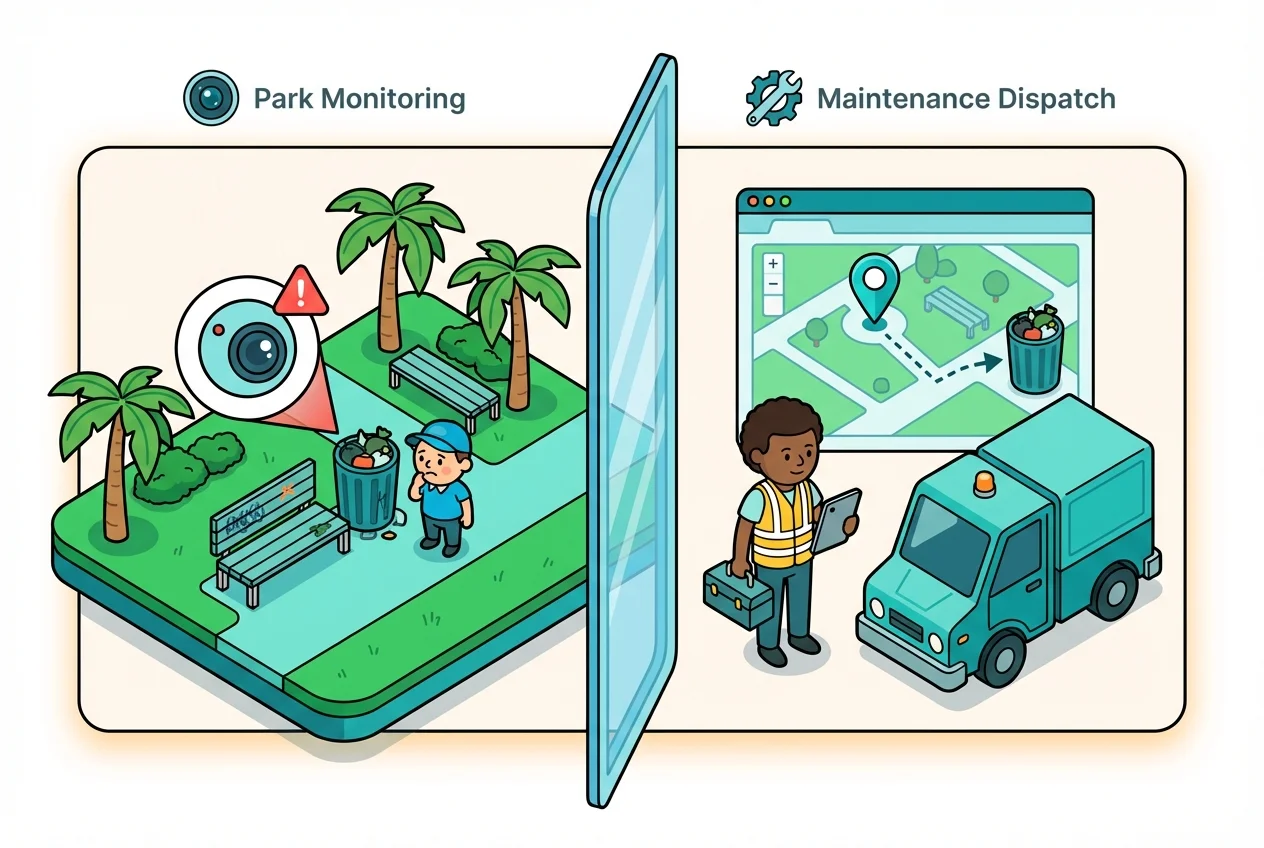
When an issue does arise, the speed and accuracy of response are paramount. Remote monitoring systems provide real-time visual evidence that enables rapid assessment and classification of problems. Whether it's identifying fresh vandalism, spotting a fallen tree branch after a storm, noticing overflowing waste bins, or detecting unexpected damage to equipment, visual intelligence allows managers to understand the situation immediately. This capability is crucial for effective proactive triage.
Instead of sending a team blindly to investigate a reported issue, managers can differentiate between urgent, immediate-response tasks (like a safety hazard) and those that can be scheduled for routine maintenance (like a minor crack in a pathway). This optimizes dispatch decisions, ensuring that the 'right' team with the 'right' equipment is sent the first time, minimizing wasted trips and maximizing efficiency. This approach moves parks operations from a reactive 'discover and react' model to a strategic 'observe, assess, and strategically respond' framework, bolstering overall operational resilience. For instance, solving urban dog park overcrowding can be more effectively managed by understanding peak usage times through visual monitoring.
Did You Know?
Many advanced remote monitoring systems are integrating AI capabilities to detect anomalies automatically. This means the system can alert staff to unusual activity, potential hazards, or even specific types of damage, further enhancing proactive maintenance without constant human oversight.
Ensuring Accountability: Verifying Contracted Services Remotely
Managing third-party maintenance contractors – from landscaping and cleaning services to specialized repairs – often presents a significant challenge for parks departments. Verifying the completion and quality of their work typically requires on-site supervision, which is resource-intensive and prone to disputes. Remote monitoring offers an objective solution.
Live and recorded camera feeds provide undeniable proof of service completion, adherence to schedules, and the quality of work performed. Did the landscaping crew mow the entire area as agreed? Was the trash removed from all designated bins? Was the pressure washing completed to standard? Managers can verify these details remotely, eliminating guesswork and reducing the need for physical inspections. This leads to improved contractor accountability, significantly fewer disputes, and ensures that municipal funds are spent effectively, preventing 'ghost' services or incomplete work. Departments leveraging visual verification can see a 15-20% reduction in contractor-related disputes and a marked improvement in service delivery. This level of transparency also helps in justifying 2026 boarding rate increases for pet boarding facilities, by visually proving the quality of care.
Key Benefits of Remote Contractor Verification
- Objective proof of service completion
- Reduced disputes and improved contractor relations
- Enhanced accountability for all parties
- Efficient use of municipal funds
- Minimized need for on-site supervision
Data-Driven Advocacy: Proving Resource Needs and Impact to Councils
Beyond immediate operational efficiencies, advanced remote monitoring systems generate invaluable data that can transform strategic planning and budget advocacy. These systems can track amenity usage heatmaps, identify peak activity times, and analyze visitor flow patterns across different park areas. This objective data moves discussions from anecdotal observations to evidence-based insights.
This data is a powerful tool for justifying budget requests to municipal councils. Need additional staffing for a popular playground? Usage data can prove its high demand. Advocating for equipment upgrades or facility expansions? Visual evidence of wear-and-tear and capacity strain provides compelling support. By demonstrating the tangible return on investment (ROI) of smart park investments – in terms of operational efficiency, measurable cost savings, and improved resident experience – departments can secure the resources needed to thrive. This data-driven approach also informs future planning, allowing for strategic resource allocation based on actual usage patterns, ensuring that parks evolve in alignment with community needs. Understanding amenity usage data is key to justifying Parks & Rec budgets.

"The real-time data from our monitoring system transformed our budget presentations. We went from 'we think we need more staff' to 'here's definitive proof of peak usage and the resulting maintenance demands.' It's a game-changer for securing critical funding."
Frequently Asked Questions
What kind of amenities can be monitored remotely?
Remote monitoring systems are highly versatile and can be used for a wide range of park amenities. This includes playgrounds, sports courts (tennis, basketball, pickleball), dog parks, picnic areas, fitness stations, community gardens, trailheads, and even restrooms. Any area where visual confirmation of status or activity is beneficial can be monitored.
Is remote monitoring a substitute for human staff?
No, remote monitoring is not designed to replace human staff but rather to empower them. It acts as a force multiplier, allowing lean teams to work smarter and more efficiently. By automating routine checks and providing immediate visual context, staff can reallocate their time from mundane patrols to higher-value tasks, actual maintenance, and direct community engagement.
How does remote monitoring help with budget optimization?
Remote monitoring optimizes budgets by significantly reducing operational costs. This includes decreasing fuel expenses and vehicle wear from fewer truck rolls, minimizing wasted staff time on unnecessary inspections, improving contractor accountability to ensure funds are well-spent, and providing data to justify future budget requests more effectively. It shifts spending from reactive crisis management to proactive prevention.
What about privacy concerns for park visitors?
Privacy is a critical consideration. Remote monitoring systems for parks are typically deployed in public, open areas, focusing on amenity status and general activity, not individual identification. Best practices include clear signage indicating camera use, ensuring cameras are not pointed at private residences, and adhering to strict data retention policies. The focus is on operational efficiency and safety, not individual surveillance.
Can these systems integrate with existing park management software?
Many modern remote monitoring platforms are designed with API capabilities, allowing for integration with existing park management, work order, or facility scheduling software. This creates a more cohesive operational ecosystem, where visual insights can directly inform maintenance workflows and resource allocation within your current systems.
Conclusion: The Future of Parks Maintenance is Smart and Proactive
The challenges facing municipal parks departments are significant, but so are the opportunities presented by smart technology. Remote monitoring isn't just a convenience; it's an essential tool for modern, resource-constrained parks departments to achieve enhanced efficiency, significant cost savings, and a measurably improved resident experience. By shifting from a reactive stance to proactive, data-driven management, parks can ensure their spaces remain vibrant, safe, and well-maintained for years to come. Investing in smart park technology is an investment in sustainable, optimized operations that truly serves the community.
Ready to transform your park operations for 2026 and beyond? Discover the power of real-time amenity viewing by exploring our solutions or scheduling a consultation with our experts.