The significant investment by municipalities and the EPA in 'smart park' infrastructure for 2026 marks a pivotal moment for urban planning and public spaces. This commitment aims to transform how we manage and experience parks, leveraging technology for greater efficiency and sustainability. However, while sensor data offers valuable insights into environmental conditions, resource usage, and visitor patterns, it often presents a critical blind spot. Relying solely on data points can lead to misinterpretations, false alarms, and inefficient resource deployment, undermining the very goals of smart park initiatives. The true revolution lies in combining these sophisticated IoT sensor networks with real-time visual feeds, providing unparalleled context and enabling truly proactive, informed, and responsive park management.

The 2026 Smart Park Revolution: Beyond Basic Connectivity
The vision for 'smart parks' in 2026 extends far beyond simple Wi-Fi hotspots. Municipalities are embracing a comprehensive suite of technologies, from intelligent waste management systems that signal when bins are full to advanced air quality monitors and sophisticated visitor flow analysis tools. At the heart of this transformation lies smart irrigation, a critical component designed to conserve water and maintain healthy landscapes. These initiatives are driven by pressing goals: enhancing sustainability, boosting operational efficiency, ensuring public safety, and significantly improving the overall visitor experience. The backbone of this revolution is a robust network of municipal IoT sensors, fueled by substantial financial and policy drivers aimed at building resilient, future-ready urban environments. The EPA's focus on sustainable infrastructure, coupled with local government commitments, is channeling billions into these projects, making smart parks and recreation a cornerstone of modern urban development.
Core Goals of Smart Parks
- Enhanced Sustainability & Resource Conservation
- Optimized Operational Efficiency
- Improved Public Safety & Security
- Elevated Visitor Experience
- Data-Driven Decision Making
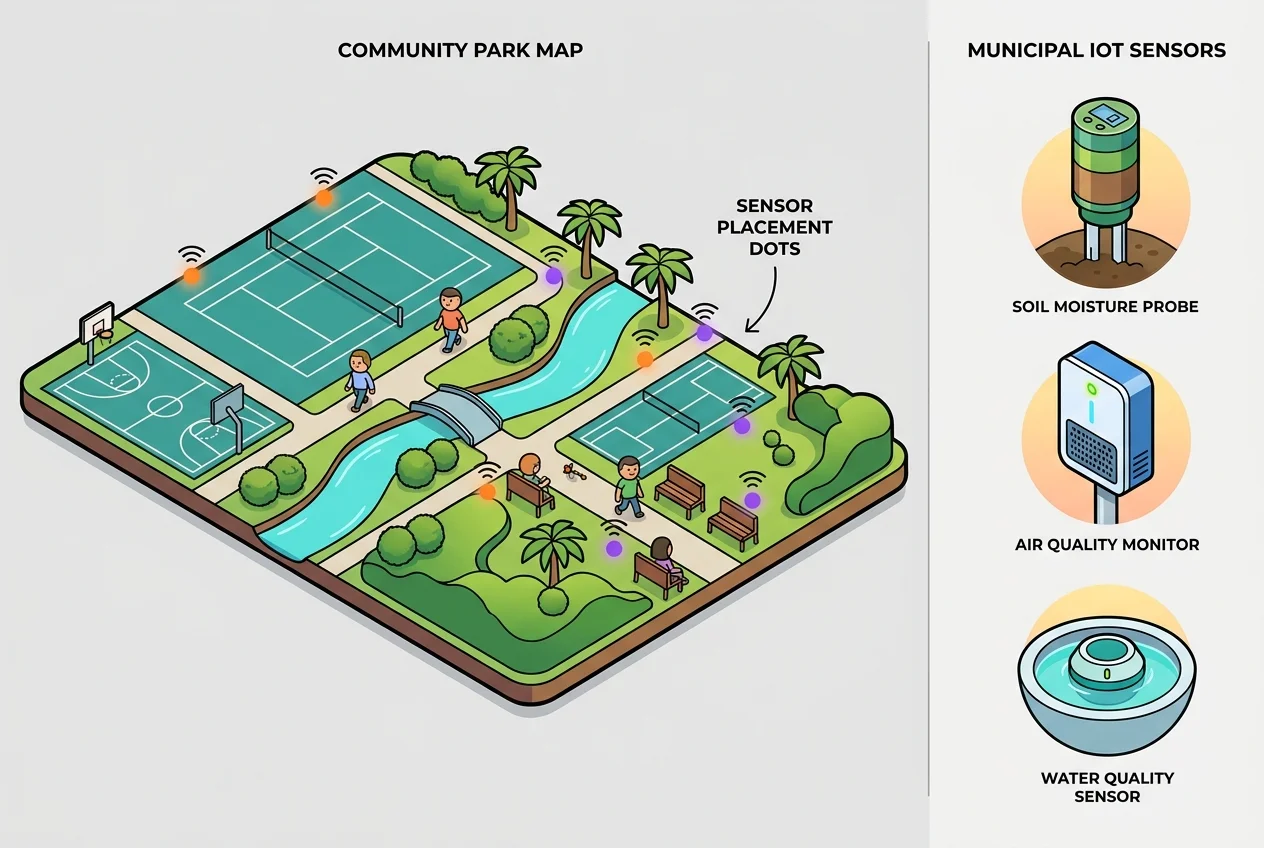
The Blind Spot: When Sensor Data Fails to Tell the Whole Story
While municipal IoT sensors are invaluable, relying solely on their data can create significant blind spots. These devices excel at collecting specific metrics but often lack the contextual awareness needed for accurate interpretation. False positives are common; an irrigation sensor might detect low soil moisture, triggering an alert, yet a localized downpour could have occurred minutes earlier, rendering the alert misleading. Similarly, motion sensors intended for security might be triggered by wildlife, or a waste bin sensor could fail to register its fullness due to a jammed lid, leading to unnecessary dispatches or overflowing bins.
The tangible costs of acting on incomplete or misleading data are substantial. Unnecessary staff dispatches to investigate false alarms can waste valuable time and fuel, diverting resources from genuine needs. For instance, an estimated 30% of field service dispatches for sensor-triggered alerts in urban infrastructure prove to be unnecessary due to a lack of visual context. This inefficiency not only strains budgets but also reduces staff morale and responsiveness to real issues. Understanding the 'why' behind the data is crucial for effective park management technology.
Sensor data provides the 'what,' but without visual context, it often fails to provide the critical 'why,' leading to inefficient resource allocation and delayed responses to actual problems.
Visual Verification: The Missing Link for Proactive Park Management
This is where real-time visual feeds emerge as the essential complement to IoT sensor data, providing immediate, undeniable context. Imagine a scenario where a sensor flags an anomaly: instead of dispatching a team blindly, an operator can instantly access a live camera feed of the area. This allows for visual verification of the alert, helping to understand the 'why' behind the data. Is that high water flow reading due to a broken pipe, or is it just a scheduled sprinkler test? Is the motion sensor triggered by a genuine concern, or simply a deer passing through?
This capability transforms reactive responses into proactive, informed decisions. It's crucial to distinguish this from traditional security surveillance; the focus here is on operational insight, resource optimization, and validating environmental conditions. By providing a "second set of eyes," live feeds empower park management teams to accurately assess situations, prioritize responses, and avoid wasted trips, ultimately enhancing overall park management technology and efficiency. For example, understanding real-time amenity usage can help justify investments, as detailed in our guide on visual data for park budgets.
Operational Clarity
Integrating live visual feeds with sensor data allows your team to see the full picture instantly, transforming ambiguous alerts into actionable intelligence. This reduces false alarms and ensures resources are deployed only where truly needed.

Real-World Synergy: Smart Irrigation Meets Live Weather & Usage Visuals
Consider the critical application of smart irrigation parks. A soil moisture sensor detects low water levels in a specific zone, triggering an alert. Without visual context, the immediate action would be to initiate irrigation. However, with a live visual feed, park operators gain invaluable perspective. The camera might reveal a broken sprinkler head gushing water, indicating a maintenance issue rather than a need for more irrigation. Alternatively, it could show an ongoing community event on the turf, requiring irrigation to be delayed. Perhaps, unexpectedly, a localized rain shower has just passed through that specific area, making further irrigation unnecessary.
This integration leads to precise, proactive decision-making. Operators can visually confirm the actual condition, dispatch a maintenance crew for the broken sprinkler, adjust irrigation schedules around events, or cancel unnecessary watering due to recent rain. This synergy results in significant water conservation—studies show that integrating visual data with smart irrigation can reduce water waste by up to 40%—reduced maintenance costs, and dramatically improved turf health by preventing over or under-watering. It's a prime example of how combining data with visuals creates truly smart irrigation parks.

Future-Proofing Your Municipal Parks: A Holistic Approach
The power of integrated visual and sensor data extends far beyond smart irrigation. This holistic approach can transform various aspects of park management: monitoring visitor flow in real-time to prevent overcrowding, assessing the health and usage of playground equipment, or ensuring the timely availability of amenities like sports courts or pavilions. For instance, live views can optimize the management of rental spaces, as explored in our guide on pavilion rental revenue.
For municipalities, these long-term strategic benefits are profound: enhanced public trust through transparent and well-maintained spaces, achievement of critical sustainability goals, and overall operational excellence. By adopting scalable and integrated technology platforms that bridge data and visual context, cities can future-proof their parks, ensuring they remain vibrant, efficient, and enjoyable for decades to come. We encourage Parks Directors and Municipal Planners to explore comprehensive solutions that intelligently combine these powerful tools.
"Integrating live visual feeds with our existing sensor network has been a game-changer. It's not just about data anymore; it's about context, and that context allows us to be truly proactive, saving resources and vastly improving our service."
Conclusion
The future of truly smart, responsive park management unequivocally lies in the intelligent integration of IoT sensor data with real-time visual feeds. This powerful combination moves beyond mere data collection, providing the critical context needed to understand, verify, and act decisively on information. For municipal stakeholders, this translates into proactive management, optimized resources, and a superior experience for every park visitor. By leveraging this advanced technology, we can create more sustainable, efficient, and enjoyable public spaces that serve communities effectively for the next decade and beyond.
Frequently Asked Questions
How do live feeds differ from security cameras in park management?
Live feeds for operational park management focus on providing real-time visual context to sensor data, helping staff verify conditions, assess resource needs, and optimize operations. Unlike security cameras, their primary purpose isn't surveillance but rather enhancing efficiency and responsiveness to environmental and usage data, such as verifying smart irrigation alerts or monitoring amenity availability.
Can this integration work with existing IoT sensor infrastructure?
Yes, most modern platforms are designed to integrate with a wide range of existing IoT sensors and systems. The key is to select a solution that offers flexible APIs and robust integration capabilities, allowing your current sensor data to be seamlessly combined with new visual feeds for a unified operational view.
What are the main benefits for municipal budgets?
Integrating live visuals with sensor data leads to significant cost savings by reducing false alarms, minimizing unnecessary staff dispatches, optimizing resource allocation (e.g., water, energy), and extending the lifespan of infrastructure through proactive maintenance. This efficiency directly impacts operational budgets and allows for better justification of expenses, as discussed in our budget justification guide.
How does this technology improve visitor experience?
By enabling proactive management, the technology ensures amenities are well-maintained, resources are available, and issues are resolved quickly. This leads to cleaner parks, healthier landscapes, fewer disruptions, and a more enjoyable and safer environment for all visitors. It also helps manage crowds and ensure fair access to popular areas.
Is this solution scalable for different park sizes?
Absolutely. The technology is highly scalable, designed to adapt from small neighborhood parks to large municipal park systems. Solutions can be deployed incrementally, starting with critical areas like smart irrigation or high-traffic amenities, and then expanded across the entire park network as needs and budgets allow.
Ready to transform your municipal parks with unparalleled operational insight? Explore how Amenivue can bridge your sensor data with real-time visual context. Schedule a personalized demonstration today to see the future of smart park management in action.