HOA boards face immense pressure when it comes to capital improvement projects. These decisions involve significant financial stakes, impacting not only the community's reserve funds but also resident satisfaction, property values, and the overall appeal of the neighborhood. The fear of misallocating substantial resources on amenities that don't truly meet resident needs or provide sufficient return on investment is a common, and valid, concern. How do you ensure that a costly renovation, expansion, or conversion truly benefits the majority and stands the test of time? The answer lies in moving beyond guesswork and embracing objective, data-driven insights. By leveraging real-time amenity usage data, HOAs can de-risk these critical decisions, ensuring every dollar spent contributes to a thriving, future-proof community.

The High Stakes of HOA Capital Improvement Planning
Capital improvement projects for HOA communities represent substantial financial investments, often drawing heavily from carefully accumulated reserve funds. Whether it's renovating a community clubhouse, upgrading a pool, or converting sports courts, these endeavors require meticulous planning and a clear understanding of their potential impact. The quality and relevance of community amenities are directly linked to resident satisfaction, property values, and the overall desirability of the HOA. A well-utilized, modern amenity can be a significant draw for prospective residents, contributing to a vibrant and engaged community.
Conversely, investing in underutilized or unwanted amenities can lead to long-term negative consequences. These 'ghost amenities' continue to incur maintenance costs, drain resources, and contribute to resident dissatisfaction, creating a perception of wasted funds. Imagine spending hundreds of thousands on a facility that only a handful of residents ever use. This underscores the critical need for objective, defensible decisions to ensure responsible stewardship of community resources. HOA boards are entrusted with safeguarding these funds, and every capital improvement decision must be backed by solid reasoning to maximize community benefit.
Responsible capital improvement requires more than good intentions; it demands objective data to ensure reserve funds are invested wisely for maximum community benefit and resident satisfaction.
Beyond Surveys: Why Traditional Amenity Planning Falls Short
Traditionally, HOA boards have relied on resident surveys, town hall meetings, and anecdotal feedback to gauge interest in amenity upgrades. While these methods offer a glimpse into community sentiment, they come with significant limitations. Surveys often suffer from response bias, where only the most passionate (or disgruntled) residents participate, leading to skewed results. Furthermore, there's a common gap between what residents say they want and how they actually behave. An amenity might poll well, but real-world usage could be minimal.
"HOA boards often face pressure from vocal minorities. Without objective data, these voices can disproportionately influence decisions, leading to investments that don't serve the broader community."
Vocal minorities can disproportionately influence perceptions of demand, pushing for projects that cater to a select few rather than the entire community. This can lead to significant reserve fund spending on facilities that, while desired by some, are not widely utilized. The necessity of empirical, behavioral data over subjective opinions becomes paramount for accurate planning. To truly understand amenity needs, boards must look beyond what residents express and observe what they actually do.

Uncovering 'Ghost Amenities' with Real-Time Usage Data
Every community likely has them: 'Ghost Amenities.' These are high-cost, low-utilization facilities that silently drain resources without providing commensurate value to the majority of residents. Perhaps it's a rarely used tennis court, an empty fitness center during peak hours, or a community room that sits vacant for weeks on end. Identifying these assets is crucial for smart capital planning.
Amenivue's real-time camera analytics provide the objective data needed to uncover these ghost amenities. Our non-security camera systems generate detailed insights through heatmaps, occupancy counts, and peak usage times, revealing true amenity utilization patterns. You can see precisely when an amenity is used, for how long, and by how many people. This level of detail allows boards to:
- Justify Repurposing: If a tennis court sees less than 5% occupancy during prime hours, the data clearly supports converting it.
- Optimize Maintenance: Understand actual wear and tear by usage, not just calendar dates.
- Prevent Wasted Investment: Avoid upgrading an amenity that already sees minimal use.
The visual evidence provided by Amenivue's dashboards offers undeniable proof of actual usage, empowering boards to make data-backed decisions that are transparent and defensible to residents. This proactive approach ensures every dollar invested provides maximum value. For more on how we protect resident privacy, read our guide on Amenity Cameras & Privacy: A Resident-First Guide to HOA Data Protection.
The Pickleball Pivot: A Data-Driven Case Study
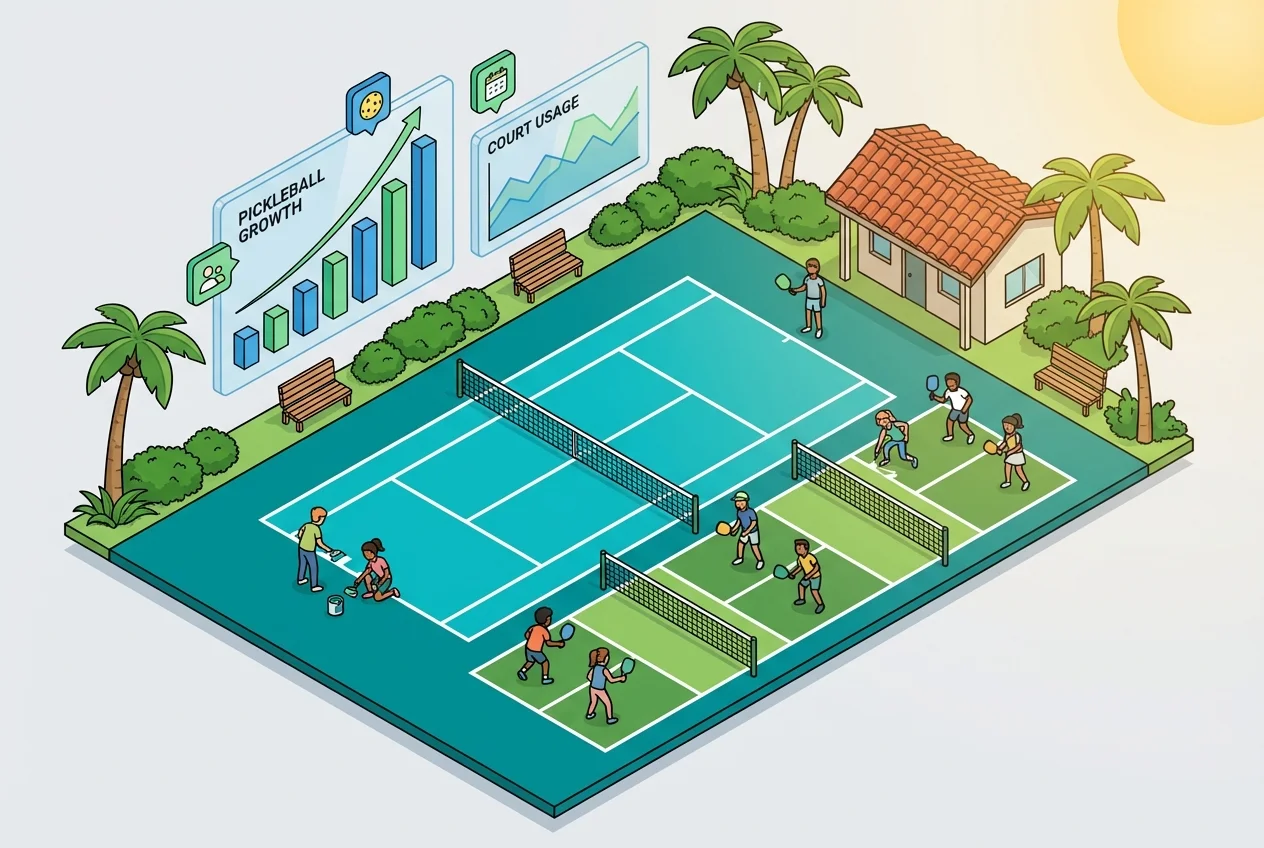
One of the most common and contentious amenity conflicts facing HOAs today is the "tennis vs. pickleball" debate. With the explosive growth of pickleball, many communities are grappling with whether to convert existing tennis courts, build new pickleball courts, or try to accommodate both. This is a prime example of an amenity demand shift that can be resolved objectively with data.
Imagine your HOA has two tennis courts that historically saw regular use. Over the past year, anecdotal reports suggest a growing interest in pickleball, but how do you justify the significant cost of converting one or both courts? Amenivue's data provides the answer. By tracking tennis court occupancy rates over several months, you might discover that usage has dropped by 60% compared to previous years, with courts frequently sitting empty. Simultaneously, resident inquiries about pickleball clinics or open play might be on the rise.
Did You Know?
Pickleball is the fastest-growing sport in America, with participation nearly doubling in just three years to 8.9 million players in 2022. This rapid growth directly impacts amenity planning in HOAs.
Concrete usage data provides an irrefutable basis for justifying a costly capital project like converting courts. When presented with objective facts – for example, "Our tennis courts are utilized only 15% of the time during peak hours, while 75% of surveyed residents expressed strong interest in pickleball" – resident conflict is minimized. The decision is no longer subjective but a transparent, evidence-based response to proven community needs, maximizing the ROI on the upgrade. This approach ensures that capital is spent on amenities that truly serve the current and future needs of the community.
Implementing a Data-Driven Amenity Strategy with Amenivue
Integrating a data-driven approach into your HOA's capital improvement planning is straightforward with Amenivue. Our non-security camera system is designed for easy, real-time collection of amenity usage data, providing insights that go far beyond simple occupancy.
Here’s how Amenivue empowers smarter decisions:
Key Amenivue Insights
- Occupancy Rates:
- See how many people are using an amenity at any given time.
- Peak Usage Times:
- Identify the busiest hours to understand true demand.
- Duration of Use:
- Track how long residents typically spend at an amenity.
- Traffic Patterns:
- Understand flow and movement within larger amenity areas.
- Historical Trends:
- Analyze usage over weeks, months, or years to spot patterns and predict future needs.
This rich dataset can be integrated seamlessly into your HOA's capital improvement planning cycle. From the initial assessment of an amenity's performance to the detailed project proposal, Amenivue provides the evidence needed to support your recommendations. Beyond major upgrades, this data can also optimize daily operations. For instance, knowing peak usage times for the fitness center can help schedule maintenance during off-peak hours or determine optimal staffing for the pool. To learn more about our features and how they can benefit your community, explore our website.
Presenting Your Data-Backed Decisions to the Community
Making data-driven decisions is only half the battle; effectively communicating those decisions to your residents is equally crucial. Transparent data presentation builds trust and credibility, especially when discussing significant capital expenditures from reserve funds.
When presenting proposed changes or upgrades:
- Visualize Data Clearly: Use Amenivue's built-in charts, graphs, and heatmaps to visually communicate findings. A heatmap showing an empty tennis court next to a graph illustrating declining usage over five years is far more compelling than just stating "tennis court usage is down."
- Focus on the "Why": Proactively use the data to address potential concerns. Explain why a conversion is necessary, why a renovation is planned, and how it benefits the broader community. For example, "This conversion addresses a 70% increase in resident interest for pickleball, while tennis court usage has consistently been below 20% capacity for the last year."
- Highlight ROI: Show how the proposed investment will increase resident satisfaction, boost property values, or reduce long-term maintenance costs.
- Invite Questions: Present the data in an open forum, ready to answer questions with objective facts rather than subjective opinions.
Pro Tip
When presenting usage data, always include a comparison point. Showing current usage alongside historical data or a target utilization rate helps residents grasp the significance of the numbers.
A data-driven approach fosters greater community buy-in and significantly reduces opposition to necessary capital projects. When residents see objective evidence, they are more likely to understand and support the board's strategic decisions.

Conclusion
Adopting a data-driven approach for HOA amenity management and capital improvement is no longer a luxury but a necessity. By leveraging real-time usage insights, boards can make smarter, more informed decisions that save money, increase resident satisfaction, and ultimately future-proof community amenities. This strategy ensures that precious reserve funds are invested wisely, aligning upgrades with actual resident needs and maximizing the value of your community's assets.
Ready to transform your HOA's capital improvement planning with objective data? Schedule a demo today to see how Amenivue can provide the real-time amenity insights you need for smarter, more confident decisions.